Self-Service Platforms

A self-service platform is an interface that enables users to perform tasks independently, offering intuitive tools, comprehensive resources, and automation to enhance efficiency and user satisfaction.

My role

  • Research

  • Prototyping

  • User testing

  • Design

Clients

Argentinean Government

Online Republic

Perceptyx

Foretrace

Airkit

Salesforce

Other clients

The project

As a product designer I've had the opportunity to work on several self-service platforms, a role I find particularly rewarding due to its emphasis on understanding user needs and interactions.

Effective self-service platforms prioritize ease of navigation, featuring clear menus and intuitive design elements to enhance user experience.

The team

The development of self-service platforms typically involves collaboration among project managers, UI designers, UX researchers, and developers.

The challenge

While tailoring platforms to individual user preferences can elevate the self-service experience, it's often a complex endeavor. Therefore, comprehensive design considerations are essential to address diverse user needs effectively.

When managing multiple platform systems, designers must establish seamless flow and simplified user experiences across all interfaces.

Perceptyx platforms images

Experience

Mi Argentina

Mi Argentina was developed to provide citizens with convenient access to governmental online services, particularly aiming to simplify processes for individuals with disabilities. Prior to the app's introduction, citizens had to physically visit various governmental entities to complete tasks. After addressing their needs, we extended its functionality to encompass a wide range of governmental procedures.

This project marked my initial foray into real-world user testing. As a member of the team, I participated in conducting interviews and gathering valuable insights.

Download Mi Argentina

Online Republic

Online Republic, now known as GoSee, is a leading global travel e-commerce company headquartered in New Zealand. During my tenure with them, I contributed to the development of three distinct platforms: one dedicated to airport car rentals, another for motorhome rentals, and a third for cruise reservations.

Designing for travel platforms presents the unique challenge of catering to a diverse global audience, necessitating an experience that is exceptionally smooth and easily comprehensible.

Airport Rentals

Perceptyx

Before the start of this project, Perceptyx operated several independent applications offering clients tools for employee surveys, people analytics, and leadership coaching. The objective of this project was to consolidate these platforms into a single landing page.

A significant aspect of this initiative involved transitioning clients from a reliance on employees to create projects to empowering them to perform certain actions independently. Concurrently, I spearheaded the development of a new platform focused entirely on self-service capabilities.

One of the highlights of this project was the establishment of a user testing process within the company, previously non-existent. Subsequently, this process was adopted by all platforms, and we evolved into staunch advocates for user-centric design.

Foretrace

Foretrace is a cybersecurity platform designed to identify threats and vulnerabilities on users' websites. In this project, my focus was on redesigning the platform to enhance user-friendliness.

With developers as the target users, my approach centered on comprehending their expertise level. It was crucial to streamline processes and furnish them with comprehensive information swiftly.

Airkit

When I began working at Airkit, it was a low-code self-service platform that enabled organizations to design, build and deploy applications faster. Given the platform's extensive functionalities, ensuring user comprehension was key.

Although our users possessed considerable technical expertise, navigating the complexity of the service necessitated a deep understanding of user interactions with the platform.

Airkit platforms images

The importance of UX

Understanding the user needs is key for any design project, but it's specially important when designing a self-service experience.

Perceptyx UX process

During the development of the Perceptyx unified landing page, I undertook the challenge of devising a process that would later serve as a blueprint for all teams.

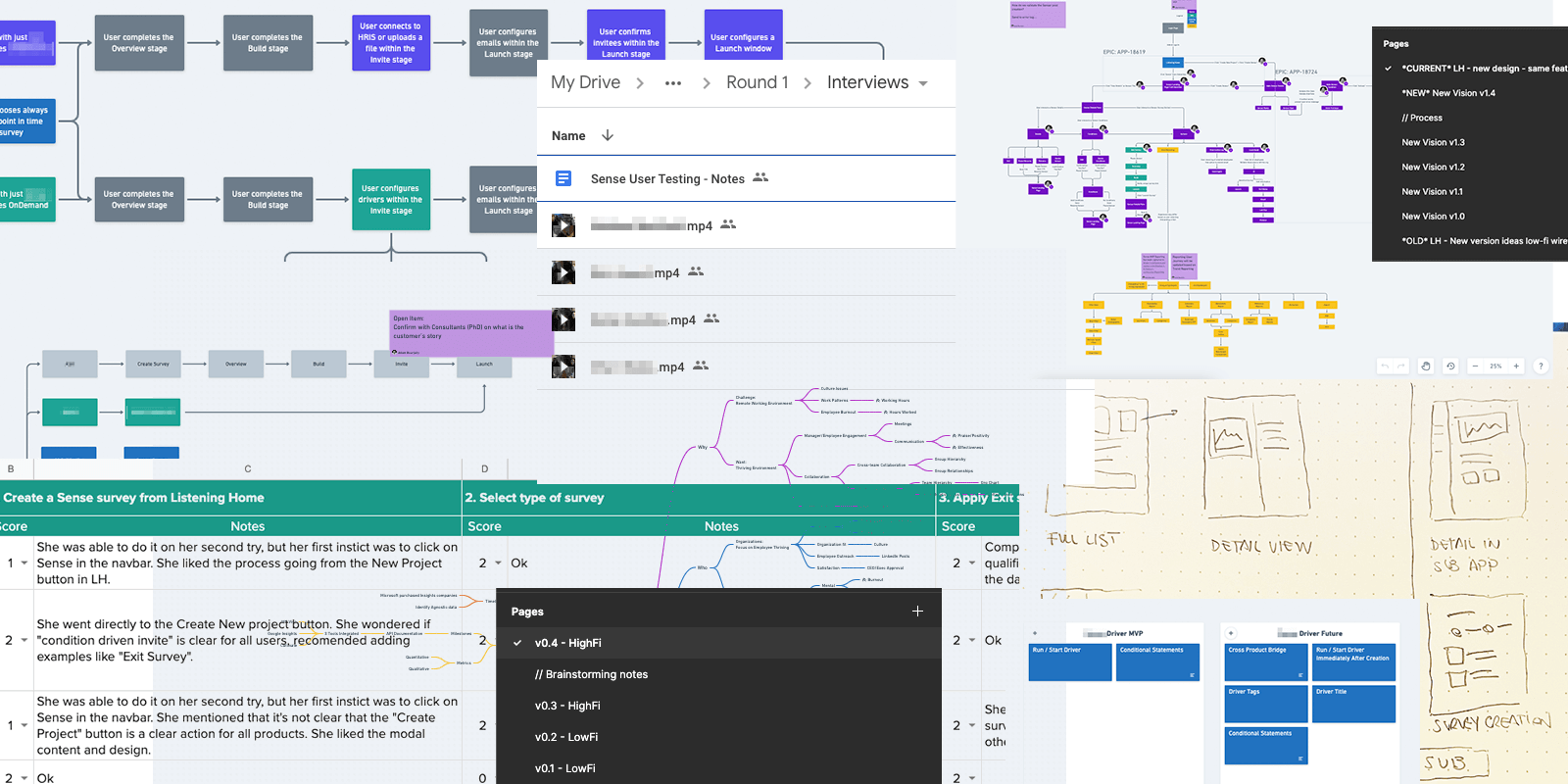
We embarked on a comprehensive discovery phase, commencing with the creation of user personas to establish the requisite features and interactions. Utilizing empathy maps for each persona aided in gaining deeper insights into their needs, followed by the development of user journeys.

Armed with the insights gleaned from the discovery phase, we proceeded to craft low-fidelity wireframes.

Conducting interviews to test these wireframes unearthed certain flow issues, which we promptly addressed.

Based on the low-fidelity wireframes and feedback from user testing, we generated the initial iteration of high-fidelity designs. Subsequent iterations involved validation with developers and feedback from stakeholders. A second round of user interviews prompted adjustments, after which our developers commenced coding.
Projects

Here you can find information about some of the projects I've worked on.